In short
- Timber gates cost less up front. Aluminium gates cost less to look after.
- A timber pedestrian gate costs about $600 to $1,500 installed.
- Manual driveway gates run $2,500 to $6,000. Automation adds $2,500 to $5,000.
- Posts, hinges and the latch decide how long any gate works properly.
Wooden gates are usually cheaper to buy and install than metal gates of the same size. Over 15 or 20 years the gap narrows, because timber needs staining or painting and can sag, while aluminium needs little more than a wash. If the lowest price today is what matters, choose timber. If you want to fit it and forget it, aluminium often costs less in the long run.
Gate prices at a glance
| Gate | Guide price, installed |
|---|---|
| Timber pedestrian gate | $600 to $1,500 |
| Manual driveway gates, timber or aluminium | $2,500 to $6,000 |
| Automation for driveway gates | $2,500 to $5,000 on top |
Guide prices for the Waikato, including posts, hinges and latch. Timber sits toward the lower end of each range and aluminium or steel toward the upper end. Only a written quote after a site visit is a firm figure.
Adding it up, an automated set of driveway gates comes to roughly $5,000 to $11,000, depending on width, material and whether the gates swing or slide.
Timber gates
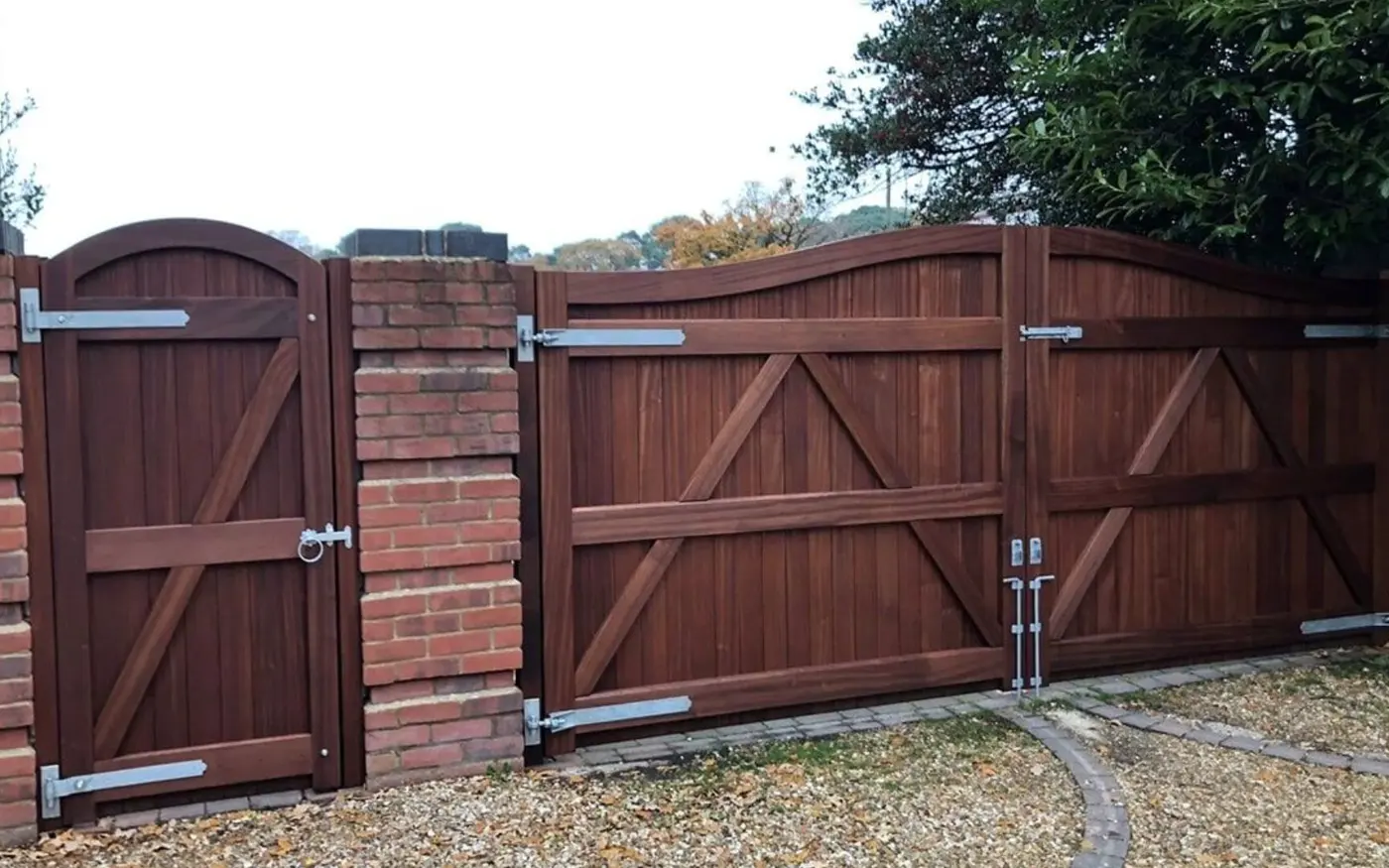
A timber gate is a frame of treated pine or hardwood with palings, boards or slats fixed to it, often made on site to match the fence.
- For: lowest price, matches a timber fence exactly, easy to make in any size, easy to repair or alter.
- Against: heavy, so it pulls on hinges and posts. Timber moves with the weather, so gates can swell and stick in winter and shrink in summer. It needs a coat of stain or paint every few years. A gate without a diagonal brace or a steel frame will sag.
Good timber gates have a brace running from the bottom hinge corner up to the top latch corner, or a welded steel frame hidden behind the boards. Either keeps the gate square.
Aluminium gates
Aluminium gates are welded frames with pickets, slats or solid infill, powder coated in the colour of your choice.
- For: light, so they are easy on hinges and motors. They do not rot, rust or warp. Upkeep is a wash. They suit automation well.
- Against: higher price. They are made to measure, so there is a lead time. A hard knock bends them, and repairs usually mean a new panel.
Steel and wrought iron gates
Steel is stronger and heavier than aluminium and suits wide driveway gates and high-security uses. It must be galvanised and coated to keep rust out, and the coating needs watching for chips. Custom wrought iron is the most expensive option and is chosen for looks.
Are aluminium gates better than wood?
| Timber | Aluminium | |
|---|---|---|
| Up-front cost | Lower | Higher |
| Upkeep | Stain or paint every few years | Wash only |
| Weight | Heavy | Light |
| Movement | Swells, shrinks, can sag | Stable |
| Life | 15 to 25 years with care | 30 years or more |
| Look | Warm, traditional, matches timber fences | Clean, modern, any colour |
| Automation | Possible, needs a strong frame | Well suited |
"Better" depends on the job. For a side gate in a paling fence, timber is the natural choice. For a driveway gate that will be opened by a motor several times a day, aluminium is easier to live with.
What installing a gate involves
The gate itself is often less than half the cost. The rest is the work around it:
- Posts. A gate post carries a swinging load, so it is larger and deeper than a fence post, often 125 mm square or steel, set 800 mm or more into concrete. A post that leans even slightly makes the gate drag or fail to latch.
- Hinges and latch. Heavy-duty, adjustable, galvanised or stainless. Pool gates need self-closing hinges and a self-latching catch at the right height.
- Ground. A swinging driveway gate needs level ground across its arc. On a sloping driveway a sliding gate or rising hinges may be needed, both of which cost more.
- Automation. Motors, a control box, safety sensors, remotes and a keypad or intercom. Power has to be run to the gate by an electrician, or a solar kit is used.
- Sliding gates. Need a concrete strip and track, or a cantilever system, and space beside the driveway for the gate to slide into.
What pushes a gate quote up
- Width. A 4 metre driveway opening costs far more than a 3 metre one, because frames, posts and motors all step up.
- Height above 1.8 metres.
- Solid infill, which is heavier and catches the wind.
- Custom designs and non-standard colours.
- Trenching for power across a driveway or garden.
- Breaking out old posts and concrete.
Cost over 20 years
A timber gate needs recoating every two to four years and may need its hinges adjusted or a brace added as it ages. If you do that yourself, the cost is small. If you pay for it, a few hundred dollars every few years adds up to a meaningful share of the price difference. An aluminium gate over the same period needs washing and the occasional hinge check.
Which to choose
- Side or garden gate in a timber fence: timber, braced, on a proper gate post.
- Pool gate: aluminium or glass, with compliant hinges and latch.
- Automated driveway gate: aluminium for most homes, steel for very wide or high-security openings.
- Villa or bungalow front gate: timber picket, painted, to suit the house.
Whatever the material, check your council's height rules for front boundaries in the fence height guide. For a written price in Hamilton or the Waikato, see the fences and gates page.
Common questions
How much does it cost to install a fence gate in NZ?
As a guide, $600 to $1,500 for a timber pedestrian gate with posts, hinges and latch, and $2,500 to $6,000 for a pair of manual driveway gates. Automation adds $2,500 to $5,000.
Do wooden gates sag?
They can, because timber is heavy and moves with moisture. A diagonal brace or a steel frame, heavy adjustable hinges and a deep, solid hinge post prevent most sagging.
Can I automate an existing gate?
Often, if the gate is square, swings freely and has a strong frame and posts. A gate that already drags or sags should be fixed or replaced first, or the motor will wear out quickly.
Sliding or swinging driveway gate?
Swing gates are simpler and cheaper where the driveway is level and there is room for the arc. Sliding gates suit sloping driveways and tight spaces, and cost more because of the track and footing.